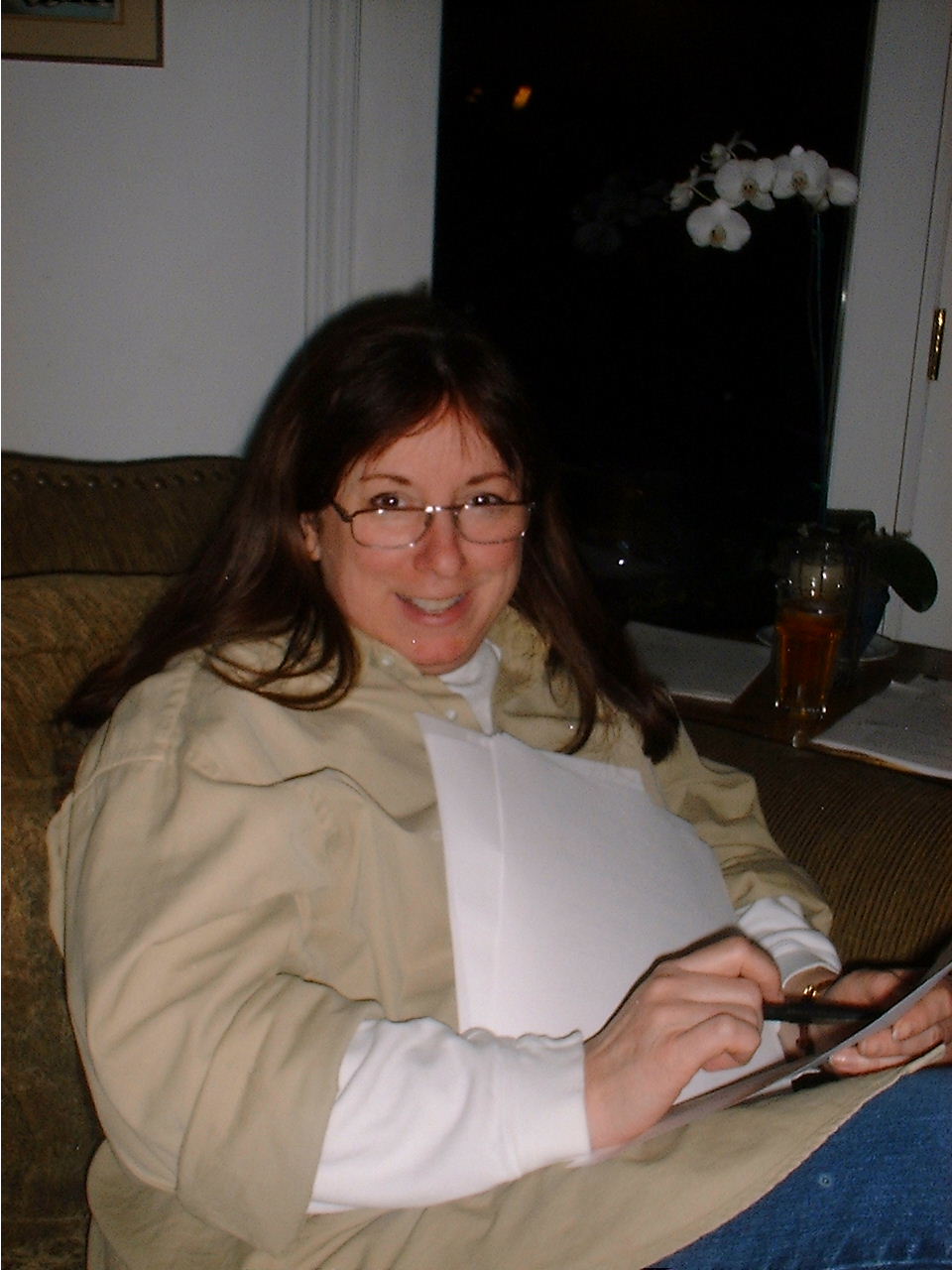
An interview with Cynthia Whitcomb
By guest interviewer Debra Stone |
In 1976, All the President’s Men took five Oscars, Steven Wozniak and Steven Jobs introduced their new machine, the Apple I and Cynthia Whitcomb sold her first screenplay. Cynthia remembers those pre-computer days well. She was working for Tony Bill (The Sting, Untamed Heart) on a book adaptation for Love Out of Season. It was her first writing assignment and she’d turned in her draft. She was at her first "notes" meeting. "When you’re young," she said, "you feel like you need to defend your work, like you need to argue their notes." That was particularly true in those pre-computer days, because every change meant you had to retype the page. "I used to sit there and with each note, my heart would sink a little more, and then there would come a point when I realized I was going to have to retype the entire script." If you’re in a notes meeting, it’s because you’re fortunate enough to have sold a spec or gotten a writing assignment. "Listen to their notes," Cynthia said. "You’ll have time to argue later. It’s just a waste of energy to do it in the room. If they ask you what you think, tell them you’re going to sleep on it. Take the notes home and think them through. You’ll have a month to write the next draft. You can always try their way, and tell them if it doesn’t work. But if they still insist, you’ve got another draft coming. Development deals typically have three drafts, so there’s time." But what about the new writers who are asked to rewrite their spec script without pay? The burden of many new writers is that most producers and agents expect at least one rewrite or polish before they’ll send it out. Cynthia believes that new writers often don’t understand that producers should not pay them to fix their own script. And they shouldn’t be expected to take out a script they don’t fully believe in. Their reputations are on the line. The way agents or producers come to believe in a script is to become invested in it by participating in developing it. "Producers are not sitting on pools of money. They want to take the best product out to market. Yours may be one of many they are trying to get a "go" on." If you catch the eye of an agent or producer who takes an interest in your writing, listen to their notes. The decision of whether to rewrite based on those notes is easy. Do you want to work with this person? If so, they need to have passion about your story and that may require a rewrite based on their notes. Listen carefully. Ask questions if you don’t understand or disagree. Ultimately, any notes you do should make sense to you. If you don’t agree with the notes, you shouldn’t do them. Finally, it’s important that everyone agrees, regardless of what happens, the writing is still completely the writer’s script. No one else gets credit because they gave notes. In Cynthia’s first book Selling Your Screenplay (Crown Publishers, 1988) she wrote that to sell a screenplay requires "a degree of talent and a willingness to work hard." That hasn’t changed, insists Cynthia. "It’s been true for hundreds of years. Geniuses that don’t work hard, don’t get anywhere. In Hollywood, the genius thing is not necessary for a screenwriter. A genius director can take a screenplay that was written by a hard-working writer and make it magic. Don’t worry if you have talent. Just do the work. I’ve seen scripts that were minimally adequate turn into something wonderful because people really worked them and they evolve. They can become surprisingly great." Because Cynthia has made her living as a professional Hollywood screenwriter for twenty-five years, her students find her a great inspiration. She has sold more than 70 feature-length screenplays, 25 of which have been filmed. Her scripts have won and been nominated for many awards including the Emmy, Humanitas and Writers Guild of America Awards. Many of her students have gone on to successful careers: Mike Werb (The Mask, Face/Off, Lara Croft: Tomb Raider); Michael Colleary (Face/Off, Lara Croft: Tomb Raider); Neil Landau (Don’t Tell Mom the Babysitter’s Dead); Gregory Poirer (Rosewood, See Spot Run, Runaway Jury); and Don Mancini (the Child’s Play franchise). "In teaching, the real me comes out in a way that’s direct and alive," Cynthia said. She wants them to believe that if she could do it, anyone can. She tells a story to help them believe. "When you start out," she said, "there will be a thousand screenwriters writing a spec to compete with you. But only half will ever finish it. And only half those will do another revision and polish, so you’re competition is cut to 250 already. By the time you finish your second, another half drop out, and your third, another half, so you’re down to 60:1 odds. By the time you write ten scripts, you’re the only one left standing. They have to hire you." Cynthia laughs at her own story. She knows the logic lies, but believes the essence of the story does not. "It doesn’t matter if the numbers really work," she insists. "It’s a motivational ploy. It keeps your left brain busy, so your right brain can write. And if you write long enough, you will sell." New writers often hear you only get one shot. Don’t take it too early. Don’t waste your chance. "Nonsense," said Cynthia. "I’m living proof you don’t only get one shot." She sent out ten scripts to ten people each. She didn’t query, she sent them cold. They didn’t prevent her from getting hired when the opportunity came. Mike Rich (The Rookie, Finding Forrester) she points out, sold his script for seven figures to a company that had rejected the very same draft. "I don’t know who made up that one shot deal," Cynthia said. "You get as many shots as you have the heart and stamina to take." After 25 years, Cynthia has a few ideas about what it takes to sustain a screenwriting career. "It can be a life of feast or famine. There is no steady paycheck. If you like roller coasters, this is the life for you." Other than that, you should watch, study and imagine movies. You must have a short memory (to let go of conflicts) and the ability to generate your own enthusiasm and passion for the work. You need to create your own positive energy. If you look "out there" for validation, you won’t find enough to make it work. "You must ask people you don’t know to give you fifteen minutes of their time. To do favors for you when they don’t owe you any favors. You just have to know that some day you will do favors for others and that’s how you will pay them back…you pass it on. But you must have the courage to ask. It can be embarrassing and hard. That’s why I have the motto from Julia (written by Alvin Sargent), ‘Work hard, take chances and be very, very bold.’ The bold is important." "I’ve seen brilliant, talented writers not go for it. They don’t take the shots. They don’t have the kind of courage to throw it in the ring. That always kind of baffles me." Not surprising from a screenwriter who’s been taking her shots—and making them—for twenty-five years. Cynthia Whitcomb is currently writing A View from Saturday for Showtime, based on a Newberry Award winning book by E.L. Konigsberg; and a Tennessee private eye project starring Lauren Holly for Lifetime. She’s also writing a Broadway-type musical based on the Warner Bros. called Hollywood Be Thy Name. Her new book The Writer's Guide to Writing Your Screenplay: How to Write Great Screenplays and Movies for Television is available on Amazon.com and in bookstores everywhere. An update of her sold-out Selling Your Screenplay will be released in September 2002. Debra Stone is a Northwest screenwriter who aspires to be one of Cynthia’s "student successes." Her script recently placed in the top ten percent at Austin and as a finalist in Sundance. Between frenzied bursts of typing you can find her advocating in court on behalf of children and serving as the Public Relations officer for Willamette Writers (a thousand-strong writers’ organization in Oregon.) |