|
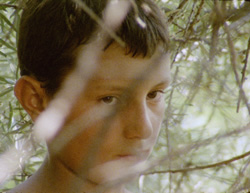
We are pleased to inform that this year’s edition of Taos
Talking Picture Festival, has nominated Don Askarian’s ON THE OLD
ROMAN ROAD, as one of the competitor-films of the festival’s
prestigious international prize. The festival screenings of ON THE
OLD ROMAN ROAD will take place during the dates from 11-14th of
April 2002.
This is what the Director of Programming of Taos Talking
Picture Festival Mr. Kelly Clement wrote about the film: "We are delighted that you have
accepted our invitation to screen ON THE OLD ROMAN ROAD at the 2002
Taos Talking Picture Festival, April 11 - 14. Every year, we look at
thousands of films and when one shines above the rest, as ON THE OLD
ROMAN ROAD did, it is indeed a pleasure. Don Askarian,
recently honored with a Harvard Film Archive
retrospective, is considered the greatest living Armenian
filmmaker. In Askarian's latest film, which he describes as “a
bloody comedy,” a man in exile remembers a childhood of magic and
mayhem, complete with grave robbers, brutal assassinations,
horses, and men buried in hot ash. As striking a visual feast as one
can find, this is an extravagant and crystalline treasure, a film
whose rewards far outweigh its considerable demands".
Retrospectives and exclusive
screenings of Don Askarians films have previously been shown at
various locations as
International Film Festival Rotterdam, 1992,
Holland;
Philadelphia Film Festival of World Cinema, 1993,
USA;
International Film Festival Figueira da Foz, 1993,
Portugal;
International Film Festival Sao Paulo, 1993,
Brazil;
ORB (Ostdeutscher Rundfunk ), TV, 1993,
Germany;
Potsdam Film Museum, 1994, Germany;
Tokyo
International Film Festival (in Kyoto), 1994, Japan;
Don Askarian
Film Festival, Yerevan, 1996, Armenia;
The International Filmfestival
Vlaanderen,Gent, 2001, Belgium;
Cine World Festival Sarasota, 2001,
USA;
The Asiaticafilmmediale, Rome, 2001 Italy.
Don Askarian’s films AVETIK, KOMITAS and ON THE OLD
ROMAN ROAD, were shown in the section “Directors in Focus” -by
Harvard Film Archive. The press release about is to be found
online on
http://www.don-askarian.am/PRESSRELEASE.html
For more information, please contact the
German office:
Frau Gaby Schein
ASKARIAN FILM
Niebuhrstrasse 69
10629
Berlin
Tel./Fax: 030-3246023
e-mail: [email protected]
With
Kindest Regards,
Nune Hovhannisyan
DON FILM
PRODUCTION & DISTRIBUTION
Aigedzori str.69a, apt.9
375019 Yerevan,
Armenia
Tel/Fax: 003741 22 70 75
e-mail: [email protected]
http://www.don-askarian.am
|
|
 |
HARVARD
FILM ARCHIVE FILMS
January 21 - January
23
Hieroglyphs
of Armenia: Films by Don Askarian |
|
The most important Armenian-born
director since Sergei Paradjanov, Don Askarian has created a
body of films that explore the history and spirit of his
native land. He does so in a modern idiom, inflected with
surrealist overtones and powerful imagery--often described as
magical realist--that embrace the extremes of beauty and
brutality. Born in 1949 in Nagorno Karabakh, in the former
Soviet Union, Askarian traveled to Moscow to study history and
art and worked as an assistant film director and film critic
before being imprisoned in 1975. Emigrating to West Berlin in
1978, Askarian began to create his meditations on Armenia from
his home in exile, beginning with an adaptation of Chekov’s
The Bear, in 1984. Since that time, he has directed a range of
works, from documentaries to biographical essays to fiction
features, that have been honored at festival screenings
worldwide.
|
 |
KOMITAS
January 21 (Monday) 7 pm
January
23 (Wednesday) 7 pm
Directed by Don Askarian
West
Germany 1988, 35mm, b/w and color, 96 min.
|
|
With Samvel Ovasapian, Onig
Saadatian, Margarita Woskanjan
German with English
subtitles
The monk soghomon soghomonian, known as Komitas,
was a renowned Armenian composer and conductor who became a
symbol of Armenian cultural unity through his orchestral and
choral performances and his late nineteenth-century travels
throughout the countryside, in which he collected peasant
songs for generations eager to preserve their cultural
heritage. In 1915, however, the musician’s career ended
abruptly after a nervous breakdown precipitated by the Ottoman
Empire’s devastation of an estimated three-fourths of the
country’s population. Wracked with pain and subjected to the
abuses of nineteenth-century psychiatric hospitals, Komitas
lost his mind and withdrew into his own world of tortured
memories for more than twenty years. Director Askarian
dedicates his beautifully constructed, ambitious, and
impressionistic portrait of Komitas to those who lost their
lives
|
 |
AVETIK
January 21 (Monday) 9 pm
January
22 (Tuesday) 7 pm
Directed by Don
Askarian
Germany/Armenia 1992, 35mm, color, 84 min. |
|
With Alik Assatrian, Mikhael
Stehanian, Karen Janibekan
Armenian with English
subtitles
Hovering between the realms of poetry and
history, this stunningly photographed, elegiac work--shot
mostly in long takes--mixes cryptic metaphor and fantastic
symbolism to tell the story of Avetik, an Armenian filmmaker
exiled in Berlin. Director Askarian employs dreamlike
images--a crumbling, ancient stone chapel gradually reduced to
nothing by the rumbling vibrations of passing military
vehicles; a ghostly cemetery of carved tombstones in which a
woman takes a starving sheep in her arm and breast-feeds it
back to life--to reflect the history of his homeland and
shades of his own exile in Germany. In sensuous, lyric
tableaux, Askarian explores German racism, the 1915 Armenian
genocide, the disastrous earthquake of 1989, tranquil
childhood memories, and images inspired by erotic medireview
poetry.
|
 |
ON THE OLD ROMAN ROAD
January 22 (Tuesday) 8:45 pm
January 23 (Wednesday) 9 pm
Directed by Don Askarian
Germany/Armenia 2001, 35mm,
color, 76 min. |
|
English and Armenian with
English subtitles
Askarian’s most recent project is another
meditation on the artist in exile. Like the filmmaker Avetik
and the real-life composer Komitas from his previous films,
Levon--a writer of Armenian extraction now living in
Rotterdam--is caught between memories of homeland and the
realities of contemporary life. From his Dutch domicile, Levon
reminisces about his brother-in-law (a hairdresser who robs
dead Turks), a brilliant Kurdish musician, a red-bearded
executioner, a seventeen-year-old girl with chestnut-colored
skin, and a Turkish Apollo with eight wives who likes to bury
himself in hot ash. His memory is also populated by beautiful
thoroughbred horses, stray dogs, camel drivers, soldiers, and
Turkish policemen. These poetic, almost surrealist scenes of
magic love and political cruelty are contrasted with the
reality of present-day Rotterdam, presented in the guise of a
modern crime story with Armenian terrorists and a Kurdish
tragedy.
|
Director Don Askarian about the film PARADJANOV
Year 1989. Rotterdam Film
Festival. Farewell at hotel "Hilton". And he speaks: «Help to shoot
"Confession"». In reply: «The child of two fathers, will be born
bastard». Actually I wanted to say: «This lustful, voracious,
scruffy lady, whose name is cinema, needs to be fucked as to... And
only loners - they were less than fingers on one hand - only those
who work in deep, infinite loneliness...». Afterwards, he was dying
long in Armenia - asking all the time to visit him, and I was
shooting "Avetik" all the time. At last, I came. He pretended he was
already dead. Then I pulled out of my pocket a cloth bought in Goa
from gipsy woman (all winds of the Indian ocean unable to overcome
the strong smell of her genitals), and unfold it. There was a lion
watching TV, there was an elephant twisting pedals... he opened his
eyes a little to look at the woman's ring, who had come with me -
the diamonds and sapphire were original. Amazed Sergey even half
rose - and the bitch-death left us alone for a couple of hours...
Then he died and there was semi-official filthy - crowd of jackals
were fighting for percents from his glory... I've told myself:
«After, after when a corpse will divide and carry away... ». And
here the film is ready. I know, it is close to your heart, and
sorry, that I'll show it to others ...
Quotation from the film.
Paradjanov: - Well, we had
tubs hanging in our toilet, and I liked it when they resonated. I
sat in the toilet, sat there long and was singing arias. Then, it
turned out that I have ballet capabilities and was given to the
ballet studio. Then father who had come to the graduation, shouted
that he does not want to have a federast son, as he said, but wants
me to dance Asian dances. But I was not good at this - Asian dances,
but, rather Saint-Sence, "The Dying Swan". And if now, at per 64, I
am checking whether I can sound high notes, I do this in the toilet
again where the same tubs are hanging - since tubs, for some reason,
do not age or wear out but live as resonators of my fate.
(Working title)
Screenplay for a full-length
film.
"One third is loosely based on the medireview
Chinese story "The Resurrection of Lyan-So". In expressing my
gratitude to the author Pu Sun Lin for his superb silken thread,
I'll say only that it has gone into a cloth worked differently to
literature, and that one ink alone would not be enough for its
serpent's skin coloration.
"It was decided to drink tea in the garden.
She was bringing the spoon up to her mouth, when he spoke, and a
drop of hot golden honey fell onto her breast. She turned to reach
for a napkin, but he was already bending over her and his cool lips
kissed the sweet, fragrant butterfly embroidered on her exquisite
dress of antique Chinese silk.
Liquid
gold oozed over the turquoise of the butterfly's wings, and they
began to change color as we looked on ... He began to smoke to calm
his heart and she had fallen into a sleep that was momentary, but
deep as death, when a shadow flitted in the air and a large
butterfly came gliding softly and precisely down onto the bruise,
fluttered its satin emerald wings and felt the large, still tumid
pink nipple of her small round breast with its
proboscis".
Don
Askarian
|